terça-feira, 12 de março de 2013

What is Solar Energy?


The Solar Energy is the name giving to all the ways of getting bright energy. Thermal energy (and its combinations) comes from the sun, and after this, the transformation of this energy captured in some useful way for people on Earth, it can be to heat the water or it can be used by eletric energy or thermal energy.
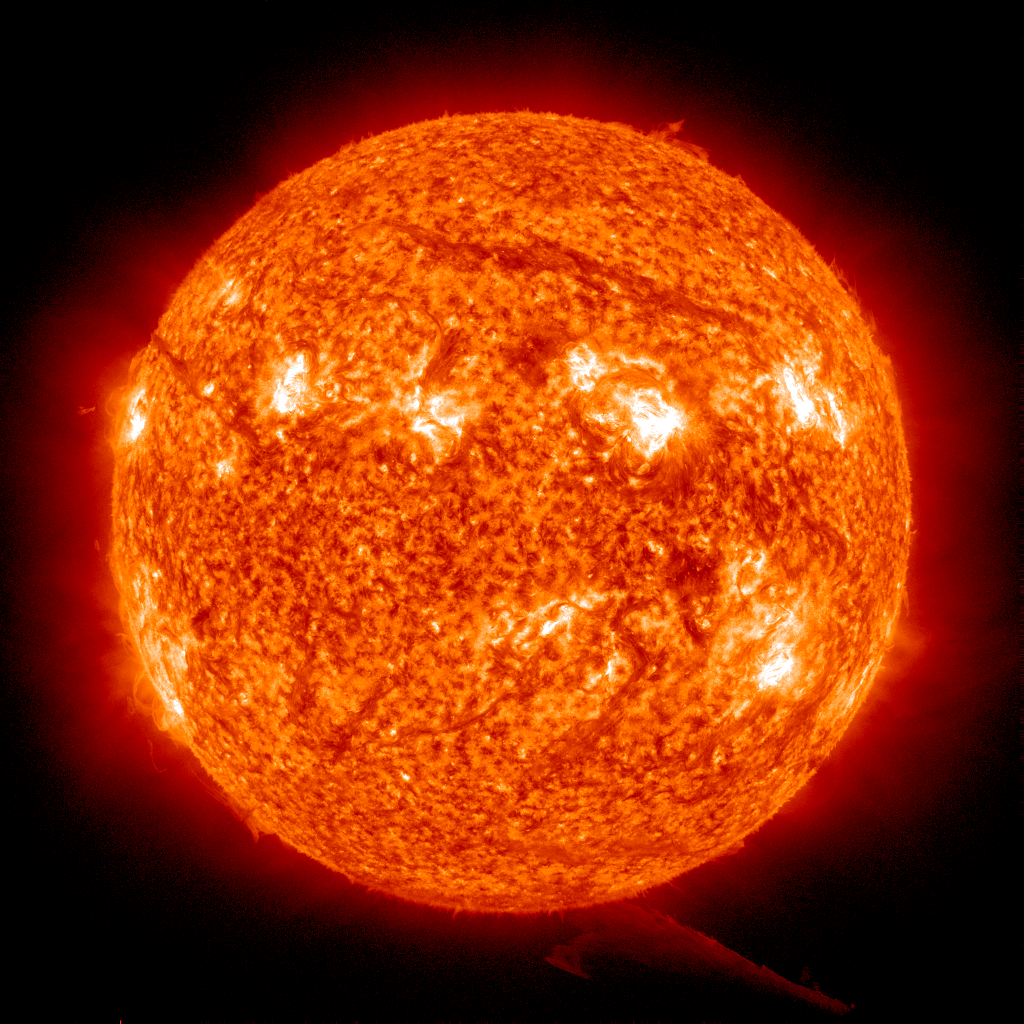
The Earth in its translation Moviment around the south, receives 1410 W / m² of energy, this was taken in the surface normal (at right angles) with the sun .. Something like 19% of this is by catching the atmosphere and 35% is reflected by the clouds. When it pass on the atmosphere, the majory of the U.S. dollar energy is in the form of visible light and ultraviolet light.

Where is it taken from?


The earth's surface, the oceans and the atmosphere takes the solar radiation, and this let its high temperature. The hot air wich conteins water evaporated from the oceans goes up on the Resulting circulção and atmospheric convection. When the air goes to high altitude where the temperature is low, the vapor of the water condenses and the clouds appear. The solar light taken from the oceans and the masses of earth keeps the surface at an average temperature of 14 ° C.


Who can this energy be useful for?

The photosynthesis of green plants convert the energy in the solar energy chemistry, wich produces food, wood and biomass
The plants every day use this energy on the proccess of photosynthesis. We use this energy we burn wood fuels or minerals. There is some technics to create fuel from the solar light absorption in the reaction chemistry, like photosynthesis in the plant, without the presence of the plants.

Why use this kind of energy?

The solar energy doesn't pollute while its production. The pollution from the manufacture of the equipment required is for the construction of solar panels is fully controllable using the forms of controls available today. The plants require minimal maintenance. Solar panels are increasingly more powerful while its cost has been decreasing. This becomes increasingly solar energy an economically viable solution. Solar energy is excellent in remote or difficult to access since its installation on a small scale does not require huge investments in transmission lines. In tropical countries, like Brazil, the use of solar energy is feasible in virtually all the territory, and, in places far from centers of energy production, its use helps reduce energy demand and consequently these energy loss that would occur in transmission.

How can this energy be captured?


The methods of capturing solar energy are classified as direct or indirect:

Direct means there is only a transformation to a type of solar energy usable by man. Examples:
Solar energy reaches a photovoltaic cell creating electricity. (The conversion from photovoltaic cells is classified as direct, though the electricity generated will require new conversion - in luminous or mechanical energy, for example - to make himself useful.)
Solar energy reaches a dark surface and is transformed into heat, which heats a quantity of water, for instance - this principle is widely used in solar heaters.
Indirect means that there is more need for a transformation arising usable energy. Example, systems that automatically control blinds, according to the availability of light from the sun
Also classified into passive and active:
Passive systems are generally straightforward, although involved (sometimes) flows in convection, which is technically a conversion of heat into mechanical energy.
Active systems are systems that call for the aid of electrical devices, mechanical or chemical means to increase the effectiveness of collection. Indirect systems are often also active.

When does this practice begin?


In 2009, the global installed capacity of solar power was 2.6 GW, about 18% of the installed capacity of Itaipu. The main producing countries, curiously, are located in middle and high latitudes. The largest producer was Japan (with 1.13 GW), followed by Germany (794 MWp) and United States (365 MW) [11].
Came into operation on 27 March 2007 the Central Serpa Solar Photovoltaic (CSFS), the largest unit of its kind in the world. It is situated in the parish of Brinches, Alentejo, Portugal, one of the sunniest areas in Europe. It has an installed capacity of 11 MW, enough to power about eight thousand dwellings.
However it is already designed and under construction with another center about six times the capacity of this production, also the Alentejo in Amareleja, municipality of Moura.
Far more ambitious is the design of a central Australian of 154 MW, capable of meeting the consumption of 45,000 homes. This will be situated in Victoria and is expected to become operational in 2013, with the first stage completed in 2010. The reduction of emission of greenhouse gases achieved by this clean energy source will be 400 000 tonnes per year.


segunda-feira, 11 de março de 2013

The results of this energy nowadays

The first photovoltaic layer consists of a single, large surface pn junction diode, capable of generating usable electrical energy from light sources with wavelengths of sunlight. These cells are typically made using silicon wafers. The first generation of cells are the dominant technology in commercial production, accounting for over 86% of the market.

The second generation of photovoltaic materials is based on the use of thin films of semiconductor deposits. The advantage of using these films is to reduce the amount of materials needed to produce them, as well as costs. Currently (2006), there are different technologies and semiconductor materials under investigation or in mass production, such as amorphous silicon, poly-crystalline silicon or micro-crystalline telluric cadmium, copper indium selenide / sulfide. Typically, the efficiencies of solar cells films are low when compared with the silicon compact but manufacturing costs are also lower, so that can achieve a lower price per watt. Also, they have reduced mass, which requires less support when placing panels on rooftops and lets arrange them and arrange them in flexible materials such as textiles.
The third generation photovoltaics is very different from the previous two, defined by using semiconductors that depend on the pn junction to separate charged particles by fotogestão. These new devices include fotoelectroquímicas cells and cells of nanocrystals.